Finally, I will cover the Retro Modern kimono fashion show by Ugawa Yu of Kimono Art & 愛loveきもの幸の会 (Ai love Kimono Yuki no Kai).
Quick apologies, I was standing in the back, and had drained the battery on my cell phone before the end of the show. Many of the photos had inadequacy focusing, especially those from my backup digital camera, but I hope I was able to capture them well enough to at least show you these gorgeous ensembles! There was a professional photographer on hand, I will likely link to his portfolio at a later date, when he processes his shots.
All of the kimono in the fashion show are from the Taisho and Showa eras. The hairstyles are also styles that were popular during that time.
The fashion show began with three girl's ensembles:
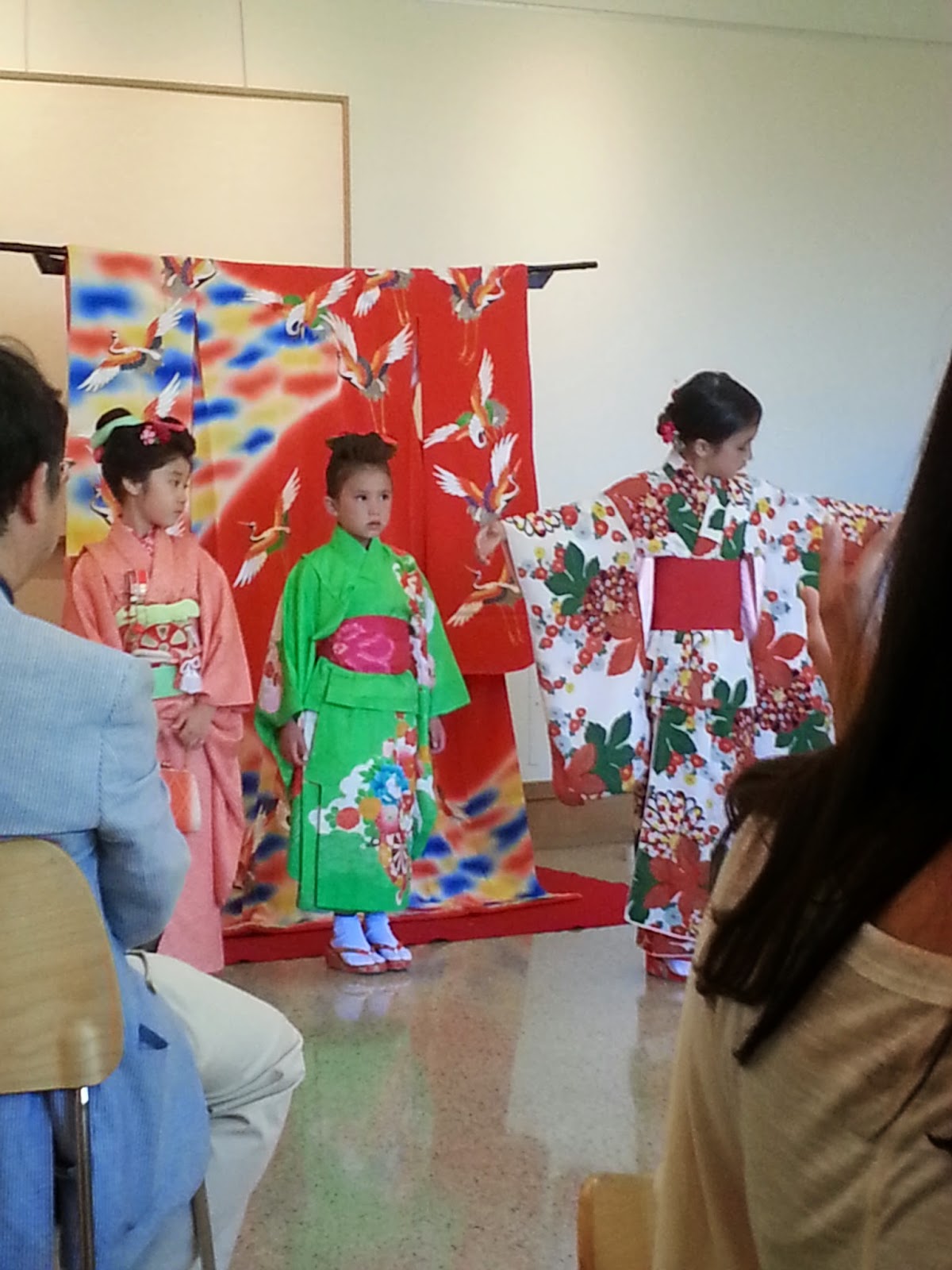
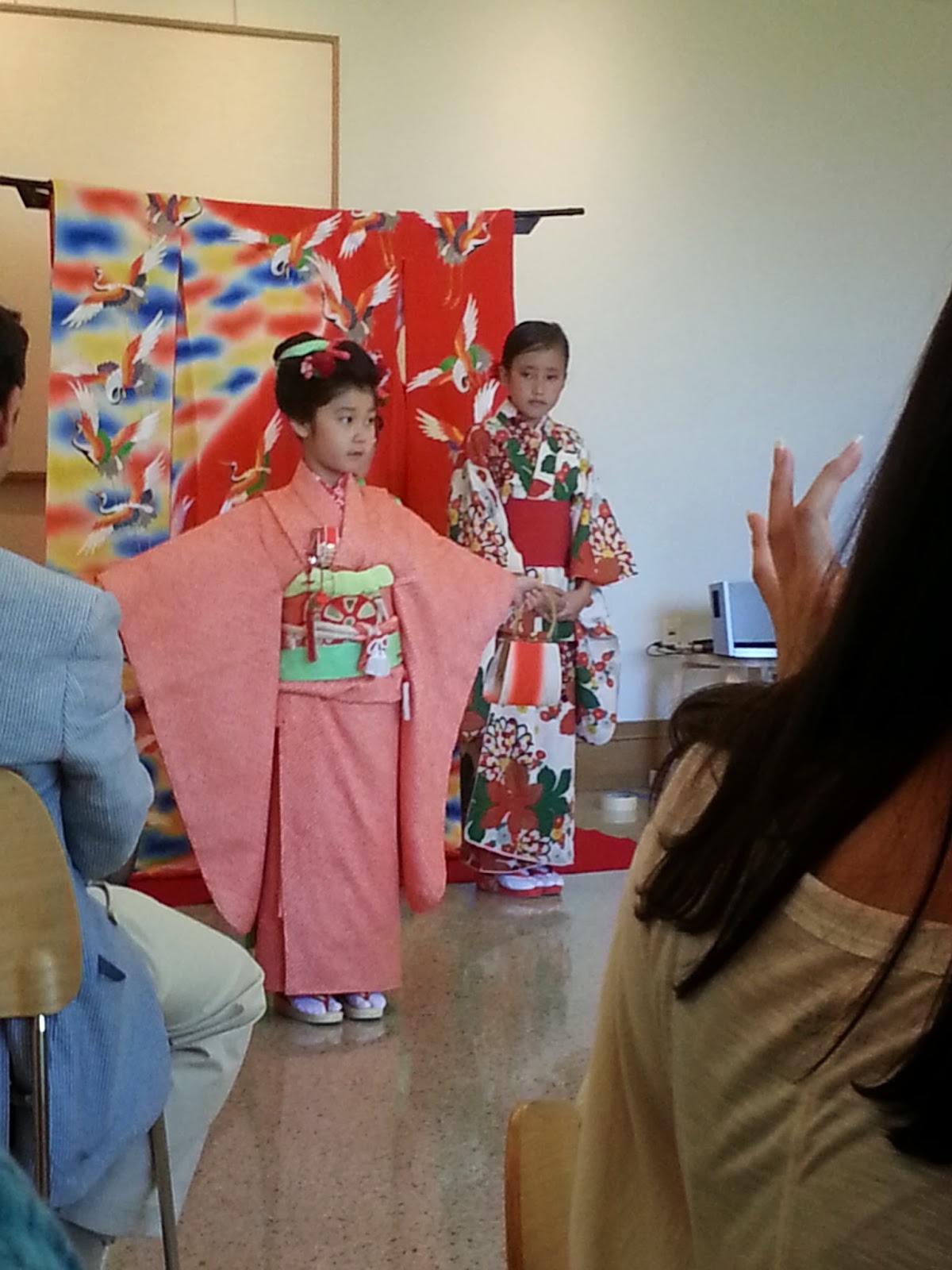
All-over shibori girl's kimono. Notice her obi is also the same shibori!

Teen models:

The first girl is wearing a houmongi with a Nagoya obi.

Her Nagoya obi is tied in a fukura suzume musubi for young ladies. Did you know you can also do fukura suzume with Nagoya obi? If you'd like to try it for semi-formal occasion, instructions can be found here (click on the Japanese text "テキストはこちら" to open PDF instructions)

Next was a furisode. This color of green and peachy orange were a common color combination.

Her obi is tied in a bunko musubi.
Next are school girl and young man's attire:
Both are wearing hakama with meisen kimono and haori. Their hairstyle is in the style that was most common for school girls ever since the Meiji era, and half up half down style called magareito (まがれいと), literally meaning "Margaret".

With their haori removed.

From behind you can see the large hair bows commonly worn with the Magareito hairstyle and hakama.


This lad is dressed as a shosei, a scholar laboror (they did general housework labor in exchange for lodging during their studies) from Meiji/Taisho era. Their general uniform consisted of a school cap (which is still used today), geta, kimono and hakama over a tall necked Western-style shirt.

A woman's everyday kimono. She is dressed as if she would be grocery shopping in the market, except she would have been wearing a kappogi apron.

She was also given a haori to wear, as the MC explained to us that women of that time would always wear a coat of some sort while outside to protect their kimono.

Next is a model dressed as a cafe girl:

She is dressed how a cafe girl would have looked in the 20s and 30s. My pictures can't even capture how gorgeously her hair is styled! Her hair is done is a style of finger waves, a typical style of both American flappers and the Japanese equivalent - the Moga, Modern Girl. The Moga modern girls were a focus of the Japan Deco exhibition that correlated with this fashion show.

View of her rose obi, and with striped haori.

Two meisen kimono, with and without haori:


Next is a focus on nagajuban:

One of the things that kimono expert Ugawa Yu is known for is "New Kimono", reinvented ways of wearing kimono in non-traditional ways, as a revitalization. Here they have dressed a nagajuban like haori, used as outerwear instead of underwear, to showcase the colorful designs that normally are not seen. The collar is simply turned under, and the nagajuban serves a new purpose.


Another nagajuban is brought out and dressed on an audience member in the style of coat. A third nagajuban has been displayed in the background.


Next we were shown two examples of chuya obi, obi which were popular for the versatility of having a different pattern on each side.


Examples of the progression of maru obi, from Taisho, Early Showa, and late Showa. We are shown that not only do the colors become brighter over time, but the weaving techniques become finer and with better details.

A supreme example of black crested haori with houmongi.


The lining is also beautifully dyed.


Furisode and men's hakama. The gentleman wears western style shoes and his coat has fish dyed at the hem. It was likely converted from a vintage tomesode. This is an excellent idea for men who wish for more decorated wafuku!

Two models with Nihongami hairstyles:


By this time my cell phone has died and I had to switch to my poor backup camera. I still managed to photograph the last pair: the bride and groom models:

Next was a furisode. This color of green and peachy orange were a common color combination.
Her obi is tied in a bunko musubi.
Both girls have their hair tied in braided buns on the side of the head, like Princess Leia, adorned with flowers. This was a common hairstyle - if I remember correctly, she said it was called something like "radio" (ラジオ), as it was reminiscent of a girl listening to the radio with headphones on.
Next are school girl and young man's attire:
Both are wearing hakama with meisen kimono and haori. Their hairstyle is in the style that was most common for school girls ever since the Meiji era, and half up half down style called magareito (まがれいと), literally meaning "Margaret".
With their haori removed.
From behind you can see the large hair bows commonly worn with the Magareito hairstyle and hakama.
This lad is dressed as a shosei, a scholar laboror (they did general housework labor in exchange for lodging during their studies) from Meiji/Taisho era. Their general uniform consisted of a school cap (which is still used today), geta, kimono and hakama over a tall necked Western-style shirt.
A woman's everyday kimono. She is dressed as if she would be grocery shopping in the market, except she would have been wearing a kappogi apron.
She was also given a haori to wear, as the MC explained to us that women of that time would always wear a coat of some sort while outside to protect their kimono.
Next is a model dressed as a cafe girl:
She is dressed how a cafe girl would have looked in the 20s and 30s. My pictures can't even capture how gorgeously her hair is styled! Her hair is done is a style of finger waves, a typical style of both American flappers and the Japanese equivalent - the Moga, Modern Girl. The Moga modern girls were a focus of the Japan Deco exhibition that correlated with this fashion show.
View of her rose obi, and with striped haori.
Two meisen kimono, with and without haori:
Next is a focus on nagajuban:
One of the things that kimono expert Ugawa Yu is known for is "New Kimono", reinvented ways of wearing kimono in non-traditional ways, as a revitalization. Here they have dressed a nagajuban like haori, used as outerwear instead of underwear, to showcase the colorful designs that normally are not seen. The collar is simply turned under, and the nagajuban serves a new purpose.
Another nagajuban is brought out and dressed on an audience member in the style of coat. A third nagajuban has been displayed in the background.
Next we were shown two examples of chuya obi, obi which were popular for the versatility of having a different pattern on each side.
Examples of the progression of maru obi, from Taisho, Early Showa, and late Showa. We are shown that not only do the colors become brighter over time, but the weaving techniques become finer and with better details.
A supreme example of black crested haori with houmongi.
The lining is also beautifully dyed.
Furisode and men's hakama. The gentleman wears western style shoes and his coat has fish dyed at the hem. It was likely converted from a vintage tomesode. This is an excellent idea for men who wish for more decorated wafuku!
Two models with Nihongami hairstyles:
By this time my cell phone has died and I had to switch to my poor backup camera. I still managed to photograph the last pair: the bride and groom models:
The show was spectacular! I truly enjoyed seeing the beautiful kimono shown by Kimono Art, and sharing them with all of you~


